Exposure-hazard multistate modeling with bmstate
Juho Timonen
20th Nov 2025
exposure-hazard.RmdThis vignette is work in progress.
Data simulation
Setup
library(bmstate)
#> Attached bmstate 0.4.0. Type ?bmstate to get started.
library(dplyr)
#>
#> Attaching package: 'dplyr'
#> The following objects are masked from 'package:stats':
#>
#>     filter, lag
#> The following objects are masked from 'package:base':
#>
#>     intersect, setdiff, setequal, union
library(tidyr)
library(tibble)
library(ggplot2)True data-generating model
# True beta
create_true_covariate_effects <- function(mod) {
  NTT <- mod$system$num_states() - 1
  C <- length(mod$covs())
  bh_true <- matrix(0, NTT, C)
  bh_true[1, 2] <- 1
  bh_true[2, 2] <- -1
  bh_true[3, 1] <- 0.3
  sn <- event_state_names(mod)
  rownames(bh_true) <- paste0("Effect on ", sn)
  colnames(bh_true) <- mod$covs()
  df <- data.frame(bh_true) |>
    rownames_to_column("event") |>
    pivot_longer(cols = -event, names_to = "covariate", values_to = "beta")
  beta_pk <- list(CL = c(0.3, -0.3), V2 = c(0.3))
  list(df = df, matrix = bh_true, pk = beta_pk)
}

# True baseline hazard parameters
create_true_baseline_hazard <- function(mod) {
  tm <- mod$system$tm()

  # Spline weights
  w_true <- matrix(0, 7, 9)
  for (j in 1:7) {
    ww <- rep(0, 9)
    if (tm$trans_df()$trans_type[j] == 2) {
      ww <- rep(-1, 9)
      ww[3:5] <- 1
    }
    if (tm$trans_df()$trans_type[j] == 3) {
      ww <- rep(-1, 9)
      ww[4:8] <- 1
    }
    w_true[j, ] <- ww
  }

  # Intercept
  w0_true <- 0.5 * 1e-3
  w0_true_vec <- rep(w0_true, 7)
  w0_true_vec[3] <- 0.1 * w0_true
  w0_true_vec[5] <- 5 * w0_true
  w0_true_vec[7] <- 20 * w0_true

  # Return
  list(w0 = w0_true_vec, w = w_true)
}

# True data-generating model
create_true_model <- function() {
  # Create models
  sn <- c("Healthy", "Bleed", "Stroke", "Dead")
  tm <- transmat_diamond(state_names = sn)
  t3yr <- 3 * 365.25
  haz_covs <- c("age")
  pk_covs <- list(
    CL = c("CrCL", "age"), V2 = "weight"
  )
  create_msm(
    tm,
    hazard_covs = haz_covs, pk_covs = pk_covs, num_knots = 8, t_max = t3yr
  )
}

# Create oracle fit draws
create_oracle_fit <- function(similar_fit, beta_true, h0_true) {
  checkmate::assert_true(similar_fit$is_point_estimate())
  weights <- similar_fit$get_draws("weights")
  weights[1, , ] <- h0_true$w
  log_w0 <- similar_fit$get_draws("log_w0")
  log_w0[1, ] <- log(h0_true$w0)

  beta_oth <- similar_fit$get_draws("beta_oth")
  beta_oth[1, , ] <- t(beta_true$matrix[, 1])
  beta_oth <- posterior::rvar(beta_oth)

  beta_xpsr <- similar_fit$get_draws("beta_xpsr")
  beta_xpsr[1, , ] <- t(beta_true$matrix[, 2])

  lp <- similar_fit$get_draws("lp__")
  lp[] <- NA
  log_z_pk <- similar_fit$get_draws("log_z_pk")
  log_z_pk[, , ] <- 0
  log_sig_pk <- similar_fit$get_draws("log_sig_pk")
  log_sig_pk[, ] <- 0
  log_mu_pk <- similar_fit$get_draws("log_mu_pk")
  log_mu_pk[, ] <- 0
  sigma_pk <- similar_fit$get_draws("sigma_pk")
  sigma_pk[] <- 0.3
  beta_CL <- similar_fit$get_draws("beta_CL")
  beta_CL[1, ] <- beta_true$pk$CL
  beta_V2 <- similar_fit$get_draws("beta_V2")
  beta_V2[1, ] <- beta_true$pk$V2

  # Create fit
  draws <- list(
    beta_oth = beta_oth,
    beta_xpsr = beta_xpsr,
    beta_CL = beta_CL,
    beta_V2 = beta_V2,
    weights = weights,
    log_z_pk = log_z_pk,
    log_sig_pk = log_sig_pk,
    log_mu_pk = log_mu_pk,
    sigma_pk = sigma_pk,
    log_w0 = log_w0,
    lp__ = lp
  )
  sd <- similar_fit$get_data()
  mod <- similar_fit$model
  MultistateModelFit$new(similar_fit$data, sd, mod, draws,
    info = "Oracle fit"
  )
}
Data simulation
mod_true <- create_true_model()
beta_true <- create_true_covariate_effects(mod_true)
h0_true <- create_true_baseline_hazard(mod_true)
simdat <- mod_true$simulate_data(
  params$N_subject,
  beta_haz = beta_true$matrix,
  beta_pk = beta_true$pk,
  w0 = h0_true$w0,
  w = h0_true$w
)
#> Recompiling Stan model
#> Using stan file at /home/runner/work/_temp/Library/bmstate/stan/msm.stan
#> Generating 600 paths
covs_dh <- unique(c(mod_true$data_covs(), "dose_amt"))
simdat_dh <- simdat$paths$subset_covariates(covs_dh, renamed_old = "dose", renamed_new = "dose_amt")
simdat_death <- as_single_event(simdat_dh, "Dead", null_state = "Healthy")

sa <- simdat$paths$subject_df$xpsr
mod_true$set_xpsr_normalizers(loc = mean(sa), scale = stats::sd(sa))
#> setting xpsr normalizers to loc = 5.34993, scale = 0.69161

simdat <- mod_true$simulate_data(
  params$N_subject,
  beta_haz = beta_true$matrix,
  beta_pk = beta_true$pk,
  w0 = h0_true$w0,
  w = h0_true$w
)
#> Generating 600 paths
print(simdat)
#> A JointData object:
#> PathData object with 600 paths
#>  * States = {Healthy, Bleed, Stroke, Dead}
#>  * Covariates = {age, CrCL, weight, dose, t_pre, t_post, conc_pre, conc_post, xpsr, ka, CL, V2, pk_lloq}
#>
#> A DosingData object with 600 subjects
Modeling
Defining models
NK <- 4
tm <- mod_true$system$tm()
pk_covs <- list(
  ka = mod_true$pk_model$ka_covs(),
  CL = mod_true$pk_model$CL_covs(),
  V2 = mod_true$pk_model$V2_covs()
)

# Exposure-hazard multistate model
mod_ms_eh <- create_msm(
  tm,
  hazard_covs = setdiff(mod_true$covs(), "xpsr"),
  pk_covs = pk_covs,
  num_knots = NK, t_max = mod_true$get_tmax()
)

# Dose-hazard multistate model
mod_ms_dh <- create_msm(
  tm,
  hazard_covs = covs_dh, num_knots = NK, t_max = mod_true$get_tmax()
)

# Survival model
tm0 <- transmat_survival(tm$states[c(1, 4)])
mod_death <- create_msm(
  tm0,
  hazard_covs = covs_dh, num_knots = NK, t_max = mod_true$get_tmax()
)
# Inference model knots
t3yr <- mod_true$get_tmax()
tt1 <- simdat$paths$transition_times()
tt2 <- simdat_dh$transition_times()
tt3 <- simdat_death$transition_times()
mod_ms_eh$set_knots(t3yr, tt1, NK)
mod_ms_dh$set_knots(t3yr, tt2, NK)
mod_death$set_knots(t3yr, tt3, NK)
# Oracle fit
fit_prelim <- fit_stan(mod_true, simdat, method = "optimize", init = 0, iter = 100)
#> Shortest time interval (0.0359547288841782) is smaller than delta_grid (1.09575). Consider increasing n_grid or decreasing t_max of the model.
#> Using stan file at /home/runner/work/_temp/Library/bmstate/stan/msm.stan
#> setting xpsr normalizers to loc = 5.42315, scale = 0.56671
#> setting max conc = 9565.56038
#> Initial log joint probability = -11306.4
#>     Iter      log prob        ||dx||      ||grad||       alpha      alpha0  # evals  Notes
#>       99      -7684.29     0.0366536       1007.03           1           1      104
#>     Iter      log prob        ||dx||      ||grad||       alpha      alpha0  # evals  Notes
#>      100      -7670.48      0.111742       2081.25           1           1      105
#> Optimization terminated normally:
#>   Maximum number of iterations hit, may not be at an optima
#> Finished in  0.2 seconds.
#> If these don't roughly match, consider refitting after setting xpsr normalizer loc and scale closer to estimated mean and sd. Otherwise interpret baseline hazards and xpsr effect size accodingly.
#>  - xpsr normalization loc = 5.42315, mean estimated xpsr = 5.4245
#>  - xpsr normalization scale = 0.56671, estimated xpsr sd = 0.73647
fit_true <- create_oracle_fit(fit_prelim, beta_true, h0_true)
fit_true$covariate_effects()
#>   covariate      beta target_state_idx target_state
#> 1       age  0.0 ± NA                2        Bleed
#> 2       age  0.0 ± NA                3       Stroke
#> 3       age  0.3 ± NA                4         Dead
#> 4      xpsr  1.0 ± NA                2        Bleed
#> 5      xpsr -1.0 ± NA                3       Stroke
#> 6      xpsr  0.0 ± NA                4         Dead
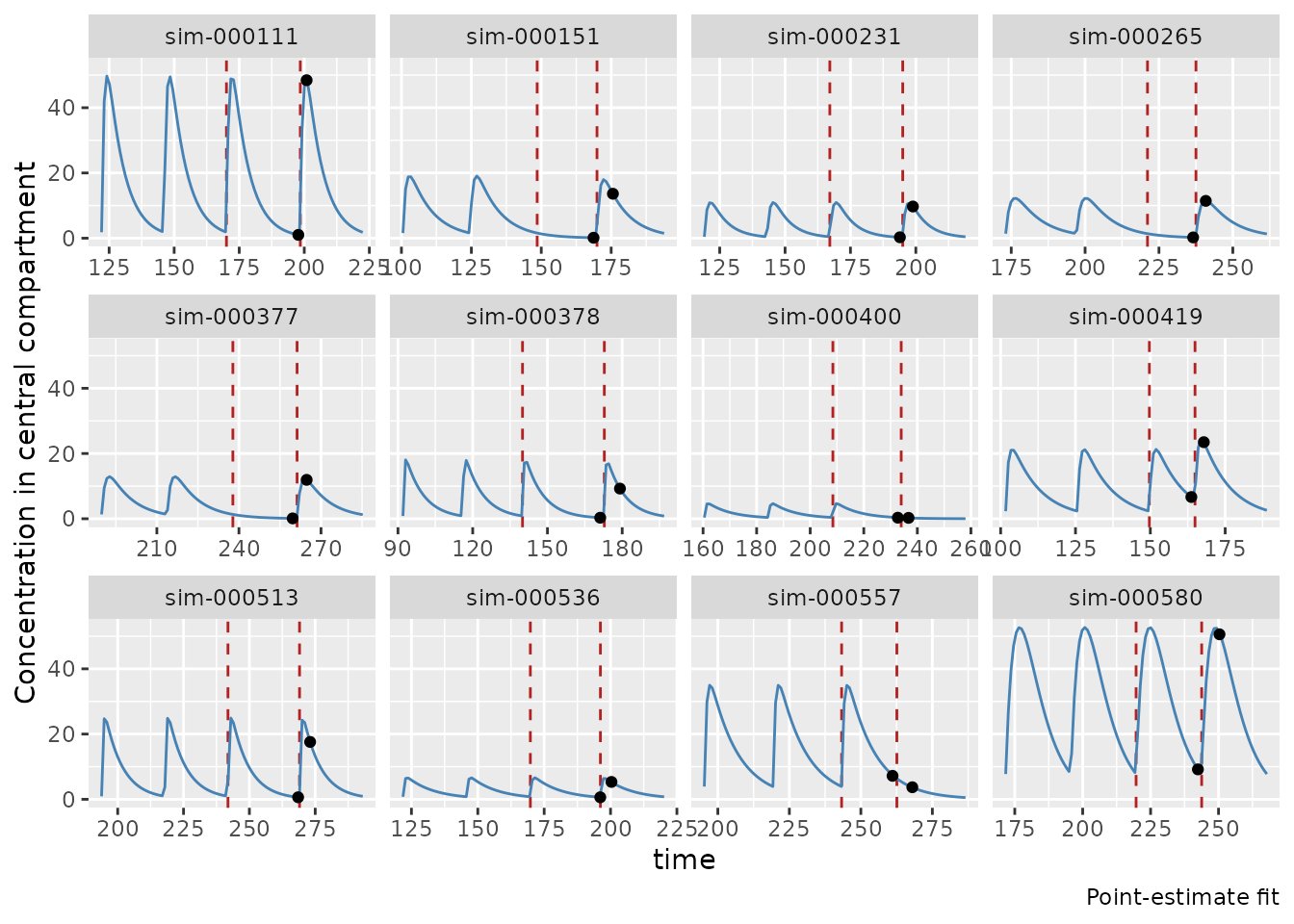
fit_true$plot_pk()
#> PK simulation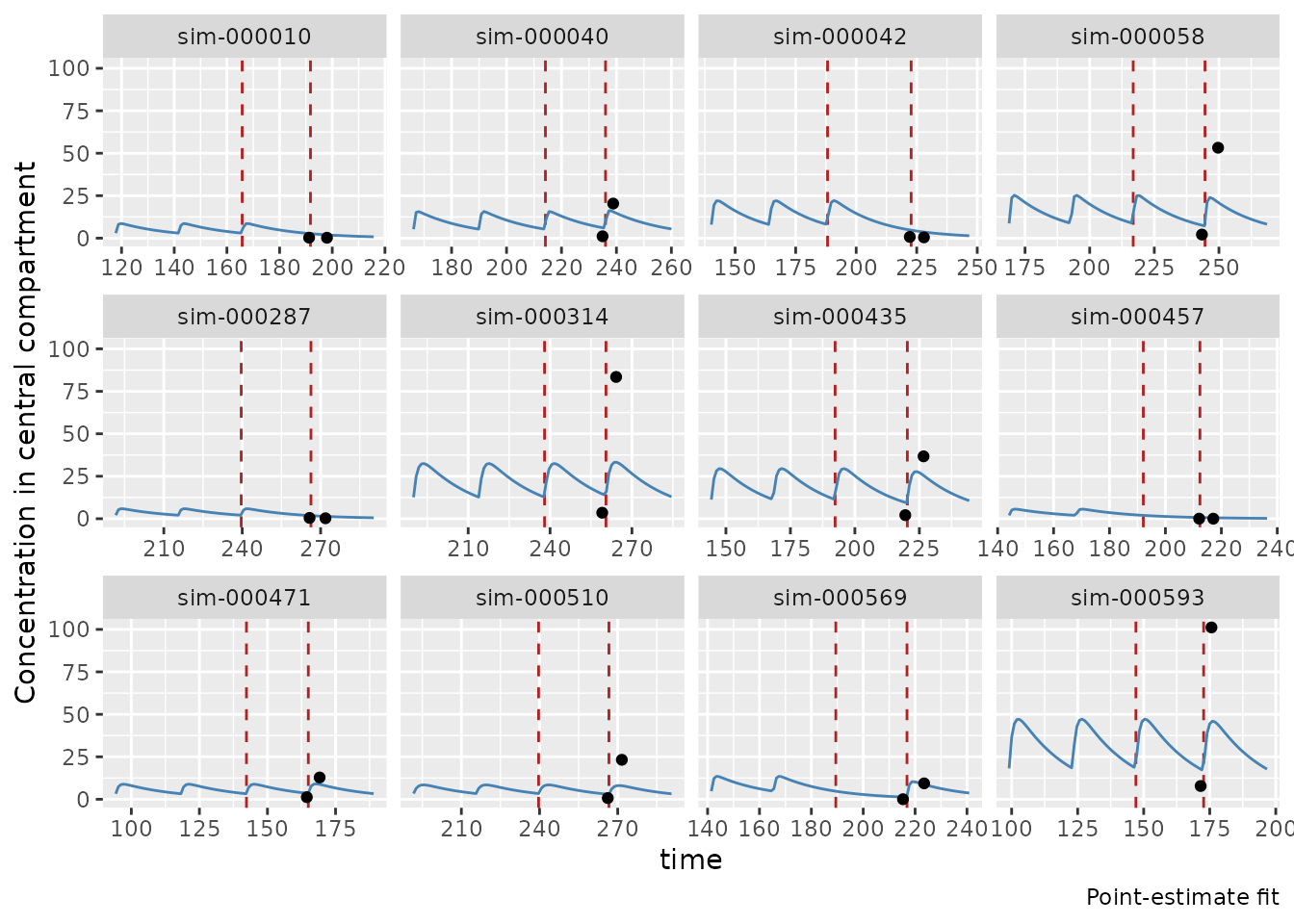
fit_true$plot_h0()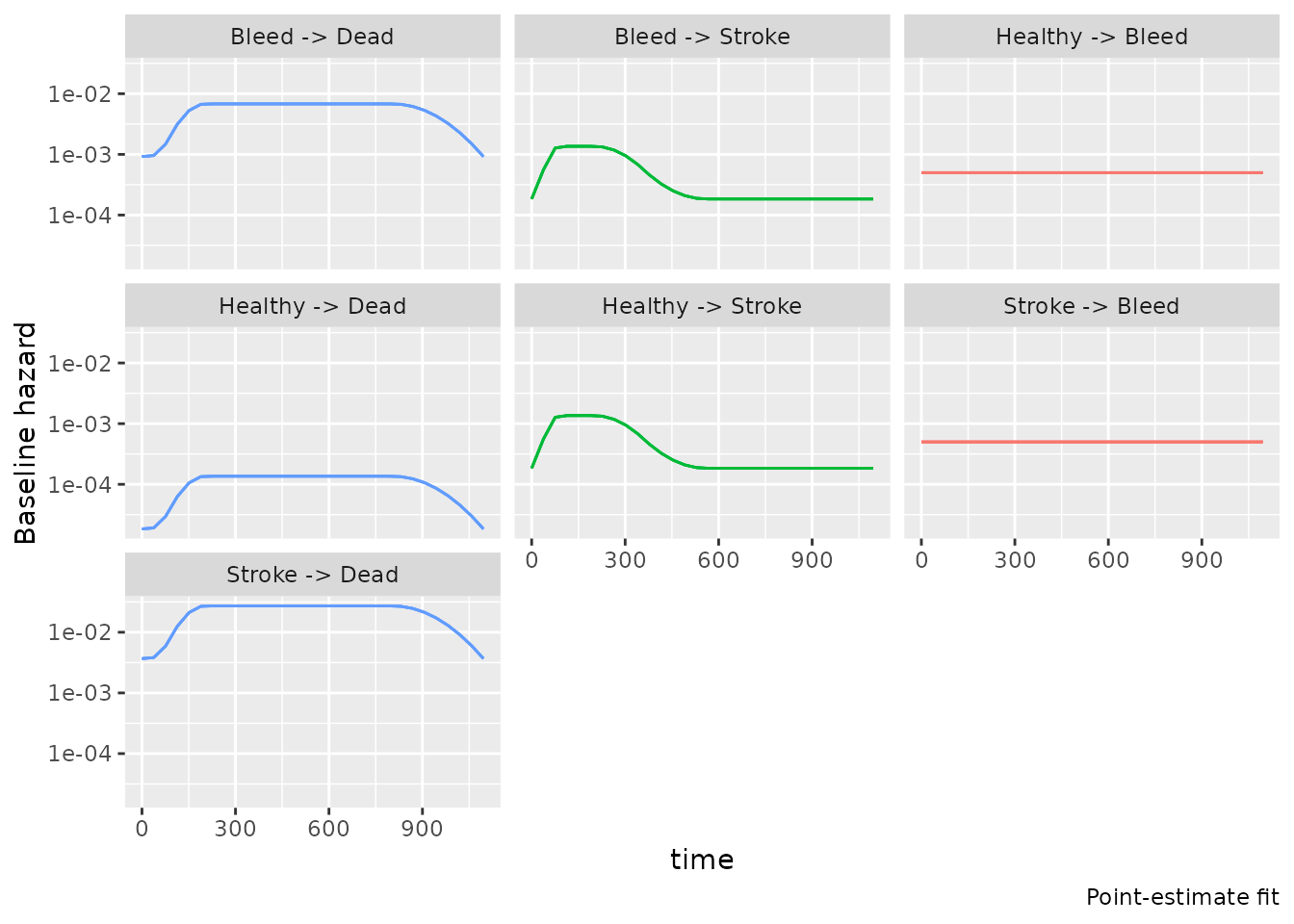
Fitting various models
fit_ms_eh <- fit_stan(mod_ms_eh, simdat, method = "optimize", init = 0)
#> Shortest time interval (0.0359547288841782) is smaller than delta_grid (1.09575). Consider increasing n_grid or decreasing t_max of the model.
#> Using stan file at /home/runner/work/_temp/Library/bmstate/stan/msm.stan
#> setting xpsr normalizers to loc = 5.42315, scale = 0.56671
#> setting max conc = 9565.56038
#> Initial log joint probability = -11156.4
#>     Iter      log prob        ||dx||      ||grad||       alpha      alpha0  # evals  Notes
#>       99      -7717.64     0.0729145       1171.84           1           1      109
#>     Iter      log prob        ||dx||      ||grad||       alpha      alpha0  # evals  Notes
#>      199      -7132.53     0.0404134       870.515           1           1      229
#>     Iter      log prob        ||dx||      ||grad||       alpha      alpha0  # evals  Notes
#>      299      -6913.43    0.00734514       1507.19           1           1      340
#>     Iter      log prob        ||dx||      ||grad||       alpha      alpha0  # evals  Notes
#>      399      -6735.44    0.00503622        2088.9           1           1      453
#>     Iter      log prob        ||dx||      ||grad||       alpha      alpha0  # evals  Notes
#>      499      -6660.31     0.0355828       859.492           1           1      565
#>     Iter      log prob        ||dx||      ||grad||       alpha      alpha0  # evals  Notes
#>      599       -6584.9     0.0163218       852.574           1           1      675
#>     Iter      log prob        ||dx||      ||grad||       alpha      alpha0  # evals  Notes
#>      699      -6529.04    0.00542709       465.525           1           1      785
#>     Iter      log prob        ||dx||      ||grad||       alpha      alpha0  # evals  Notes
#>      799      -6503.43     0.0055988       951.853      0.3624           1      898
#>     Iter      log prob        ||dx||      ||grad||       alpha      alpha0  # evals  Notes
#>      899      -6483.59     0.0265756       1063.93           1           1     1006
#>     Iter      log prob        ||dx||      ||grad||       alpha      alpha0  # evals  Notes
#>      999       -6460.4     0.0035246       552.015           1           1     1116
#>     Iter      log prob        ||dx||      ||grad||       alpha      alpha0  # evals  Notes
#>     1099      -6448.94    0.00170797       289.855           1           1     1227
#>     Iter      log prob        ||dx||      ||grad||       alpha      alpha0  # evals  Notes
#>     1199      -6441.94   0.000532439        327.47      0.3737      0.3737     1339
#>     Iter      log prob        ||dx||      ||grad||       alpha      alpha0  # evals  Notes
#>     1299      -6435.49    0.00150055       269.552           1           1     1446
#>     Iter      log prob        ||dx||      ||grad||       alpha      alpha0  # evals  Notes
#>     1399      -6431.76    0.00254161       192.315           1           1     1557
#>     Iter      log prob        ||dx||      ||grad||       alpha      alpha0  # evals  Notes
#>     1499      -6424.11    0.00085538       490.992      0.8571      0.8571     1662
#>     Iter      log prob        ||dx||      ||grad||       alpha      alpha0  # evals  Notes
#>     1599      -6412.74     0.0116704       646.135           1           1     1772
#>     Iter      log prob        ||dx||      ||grad||       alpha      alpha0  # evals  Notes
#>     1699      -6404.36    0.00407611        350.42           1           1     1883
#>     Iter      log prob        ||dx||      ||grad||       alpha      alpha0  # evals  Notes
#>     1799      -6398.57     0.0016371       234.811           1           1     1990
#>     Iter      log prob        ||dx||      ||grad||       alpha      alpha0  # evals  Notes
#>     1899       -6397.5    0.00183939       142.567           1           1     2096
#>     Iter      log prob        ||dx||      ||grad||       alpha      alpha0  # evals  Notes
#>     1999      -6396.44   0.000560921       95.6849           1           1     2209
#>     Iter      log prob        ||dx||      ||grad||       alpha      alpha0  # evals  Notes
#>     2000      -6396.43    0.00056563       231.704           1           1     2210
#> Optimization terminated normally:
#>   Maximum number of iterations hit, may not be at an optima
#> Finished in  4.6 seconds.
#> If these don't roughly match, consider refitting after setting xpsr normalizer loc and scale closer to estimated mean and sd. Otherwise interpret baseline hazards and xpsr effect size accodingly.
#>  - xpsr normalization loc = 5.42315, mean estimated xpsr = 5.50741
#>  - xpsr normalization scale = 0.56671, estimated xpsr sd = 0.96188
fit_ms_dh <- fit_stan(mod_ms_dh, simdat_dh, method = "optimize", init = 0)
#> Shortest time interval (0.0336870958247317) is smaller than delta_grid (1.09575). Consider increasing n_grid or decreasing t_max of the model.
#> Using stan file at /home/runner/work/_temp/Library/bmstate/stan/msm.stan
#> Initial log joint probability = -7578.43
#>     Iter      log prob        ||dx||      ||grad||       alpha      alpha0  # evals  Notes
#>       99      -6096.63    0.00509309       3.96255           1           1      106
#>     Iter      log prob        ||dx||      ||grad||       alpha      alpha0  # evals  Notes
#>      199      -6095.58     0.0438785       2.63666           1           1      216
#>     Iter      log prob        ||dx||      ||grad||       alpha      alpha0  # evals  Notes
#>      299      -6095.38    0.00517853       0.72308           1           1      326
#>     Iter      log prob        ||dx||      ||grad||       alpha      alpha0  # evals  Notes
#>      399      -6095.36     0.0116761      0.575551           1           1      431
#>     Iter      log prob        ||dx||      ||grad||       alpha      alpha0  # evals  Notes
#>      499      -6095.32     0.0270586       1.26346           1           1      539
#>     Iter      log prob        ||dx||      ||grad||       alpha      alpha0  # evals  Notes
#>      599       -6095.3    0.00505974      0.578409           1           1      641
#>     Iter      log prob        ||dx||      ||grad||       alpha      alpha0  # evals  Notes
#>      626      -6095.29    0.00145307     0.0857739           1           1      671
#> Optimization terminated normally:
#>   Convergence detected: relative gradient magnitude is below tolerance
#> Finished in  0.4 seconds.
fit_death <- fit_stan(mod_death, simdat_death, method = "optimize", init = 0)
#> Using stan file at /home/runner/work/_temp/Library/bmstate/stan/msm.stan
#> Initial log joint probability = -3594.95
#>     Iter      log prob        ||dx||      ||grad||       alpha      alpha0  # evals  Notes
#>       99      -3379.61     0.0192462      0.637589           1           1      107
#>     Iter      log prob        ||dx||      ||grad||       alpha      alpha0  # evals  Notes
#>      199      -3379.46     0.0480659      0.416013      0.8681      0.8681      218
#>     Iter      log prob        ||dx||      ||grad||       alpha      alpha0  # evals  Notes
#>      260      -3379.45   0.000684573     0.0415297      0.8453      0.8453      284
#> Optimization terminated normally:
#>   Convergence detected: relative gradient magnitude is below tolerance
#> Finished in  0.1 seconds.
fit_ms_eh$plot_h0()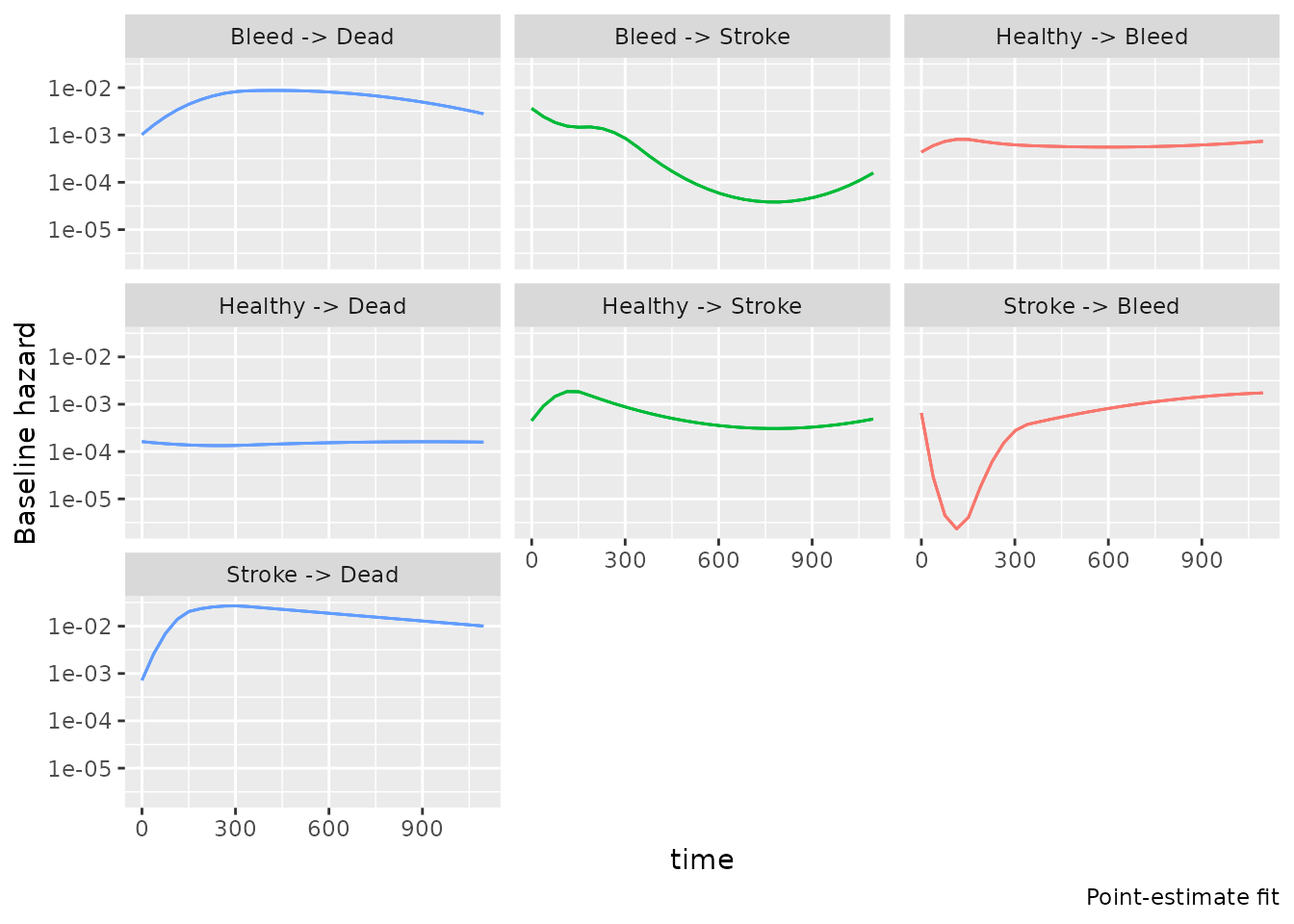
fit_ms_eh$covariate_effects()
#>   covariate       beta target_state_idx target_state
#> 1       age  0.21 ± NA                2        Bleed
#> 2       age -0.14 ± NA                3       Stroke
#> 3       age  0.23 ± NA                4         Dead
#> 4      xpsr  0.14 ± NA                2        Bleed
#> 5      xpsr -0.45 ± NA                3       Stroke
#> 6      xpsr  0.02 ± NA                4         Dead
fit_ms_dh$covariate_effects()
#>    covariate        beta target_state_idx target_state
#> 1        age  0.705 ± NA                2        Bleed
#> 2        age -0.619 ± NA                3       Stroke
#> 3        age  0.260 ± NA                4         Dead
#> 4       CrCL -0.602 ± NA                2        Bleed
#> 5       CrCL  0.514 ± NA                3       Stroke
#> 6       CrCL  0.073 ± NA                4         Dead
#> 7     weight  0.086 ± NA                2        Bleed
#> 8     weight  0.022 ± NA                3       Stroke
#> 9     weight  0.033 ± NA                4         Dead
#> 10  dose_amt  1.020 ± NA                2        Bleed
#> 11  dose_amt -1.168 ± NA                3       Stroke
#> 12  dose_amt  0.028 ± NA                4         Dead
fit_death$covariate_effects()
#>   covariate        beta target_state_idx target_state
#> 1       age -0.126 ± NA                2         Dead
#> 2      CrCL  0.181 ± NA                2         Dead
#> 3    weight  0.043 ± NA                2         Dead
#> 4  dose_amt -0.222 ± NA                2         Dead
fit_ms_eh$plot_pk()
#> PK simulation